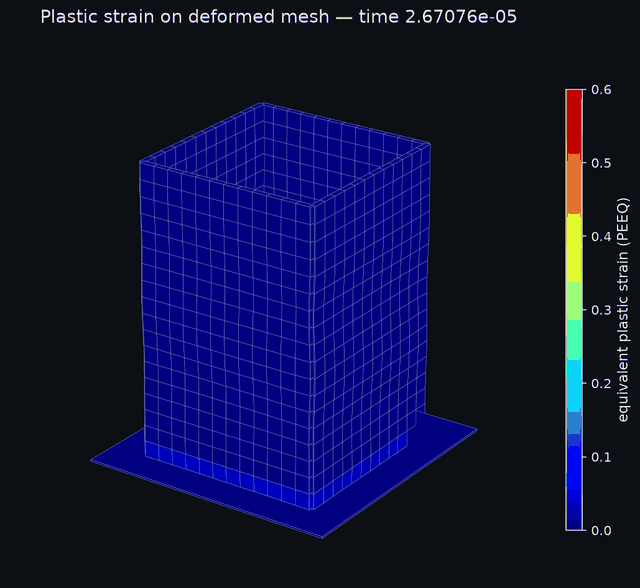
A crushed steel tube looks continuous. The solver sees small patches, stored energy, and a repeated search for the shape where no force is left unbalanced.
Step 1
A structure becomes arithmetic
The solved frame sequence could not be opened at this location.
One FINITE ELEMENT — a patch small enough that the physics inside it is simple. The computer never solves “steel”; it solves ~thousands of these patches, coupled.
color = how hard the metal is working at that spot.
Real solved sequence, not an artist’s animation. Equal time spacing across the completed 0–1.2 ms solution; the camera and 0–0.6 plastic-strain color scale remain fixed.
The continuous tube becomes a mesh: many small, tractable patches whose shared edges make them behave as one structure.
Step 2
The physics model
Schematic
The energy bowl and its slope
The bottom panel is not a second rule. It is the same physics viewed as “the force left over when you perturb u.” Read its height, not its tilt: height is how big the leftover force is, and which side of the line it sits on is which way that force pushes. It crosses zero and keeps going — rather than stopping at the crossing — because just past the bottom of the bowl there is still a leftover force, now pushing back the other way. Zero height, not the end of the line, is the answer.
Schematic
Why the fold pattern is not unique
Schematic. A Newton solve does not escape local minima — it either converges in a few corrections or the solver shrinks the time step and retries. In a real crush, WHICH minimum the metal finds is decided before Newton begins — by tiny imperfections and by the dynamics — and that is why crush models seed a deliberate imperfection into the mesh.
Roll over any symbol to see its plain-language meaning
Π(u)
=
½
uTKu
−
uTf
dΠ/du
= 0 ⇒
K u = f
Not force but ENERGY is the bookkeeping quantity — like a stretched spring, the structure pays to stay deformed, and relaxes when allowed.
Step 3
The algorithm
Roll over any symbol to see its plain-language meaning
R(uk)
=
fint(uk)
−
fext
measure the imbalance, then use local stiffness to correct the guess
uk+1
=
uk
−
KT(uk)−1 R(uk)
Guess -> measure the leftover force -> correct -> repeat. Humble arithmetic, compounded at silicon speed.
Step 4
Watch it relax
Illustration
Many coupled springs settling
kinetic energy — motion
draining
internal energy — absorbed by folding
filling
Measured
This program’s completed crush run
Loading the measured energy series…
The mesh is a network of springs. Solving = letting the springs trade length and deform until stored energy is at its minimum; in the case of metal pushed outside its elastic regime, this results in a large absorption and dissipation of the impact energy — press Play and watch the lattice settle downhill.