The Neutral Point: The CS9 Design Story
What our fast physics missed about a stability problem, what only a viscous solve could explain, and the airplane that came out the other side.
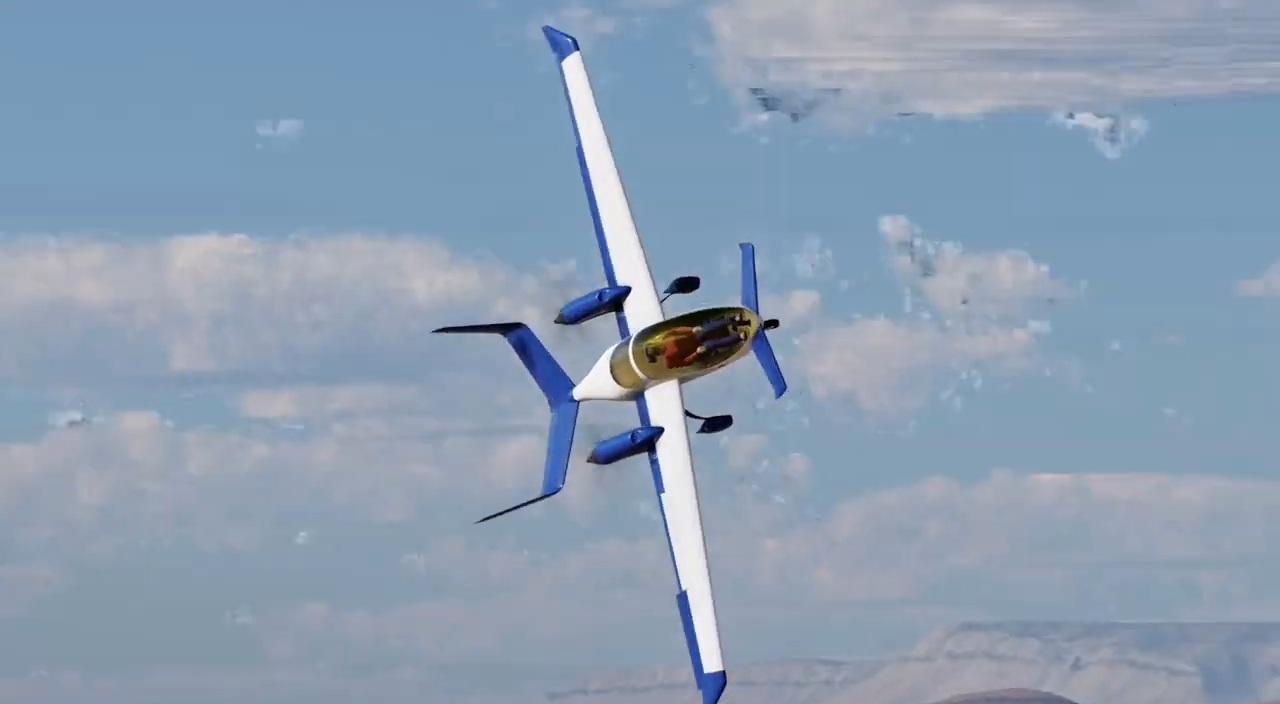
The mission
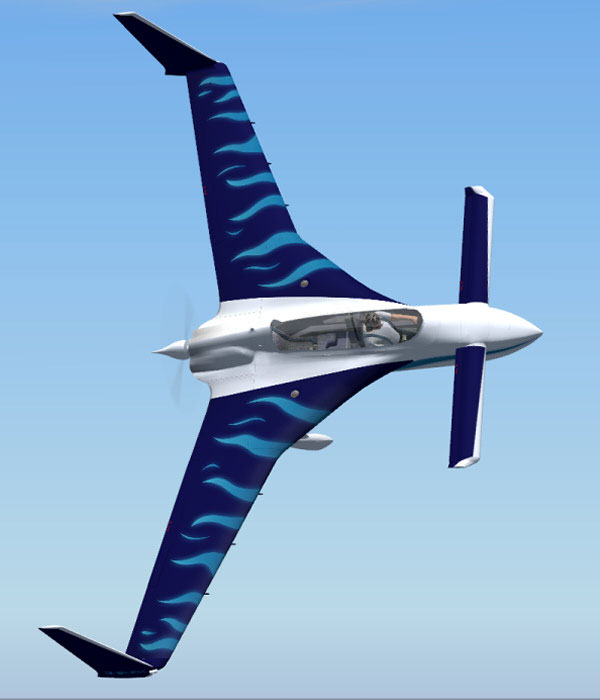
The airpark needs airplanes that are fun the way a sport bike is fun and safe the way an airliner is safe — and that can land short and slow at the end of the ride. Slow landings take flaps. Stall safety, on a small airplane, is what a canard is for: the little front wing is built to give up before the main wing does, so the nose drops and the airplane saves itself before a stall can bite. But on an aircraft this size the two do not normally go together. A canard puts the main wing well aft, so its flaps sit a long way behind the balance point; drop them and they push the back of the aeroplane up, pitching the nose down hard — and there is nothing with the authority to hold it. That is why this class of aeroplane usually flies without flaps at all. The CS9 was our attempt at both at once — a canard airplane with working flaps, its canard flap geared to the wing flaps so one lever moves everything in balance.
The anomaly
We brought the CS9 into our simulation suite from X-Plane, where it flies beautifully. Flight simulators use fast physics: each surface — wing, canard, tail — is computed in its own clean air, dozens of times a second. That speed is exactly what makes a simulator a simulator, and the per-surface arithmetic said the CS9 had a static margin of +12.4% — comfortably stable. Then we pointed our other instrument at it: computational fluid dynamics, which is far too slow to fly in real time but solves the whole airplane in one connected body of air, so the air disturbed by one surface is the same air the next surface flies in. The coupled answer: the margin isn't there. Not smaller — erased, down to roughly zero. And we found the mechanism experimentally — in our own laboratory, which is a computational one: every measurement quoted in this paper is taken in simulated flow, not in a wind tunnel and not in flight. The canard's wake washes across the wing root and steals part of the airflow the root would otherwise lean on, more and more as the nose rises. The airplane our fast model agreed on does not exist. A fair objection to that sentence — that a coupled fast method might have caught it — is taken up, and measured, in the appendix.
Neither instrument is wrong — they have different jobs, and the asymmetry between them matters to everything that follows. A flight model has to answer sixty times a second, continuously, for every combination of angle, control and gust; only per-surface arithmetic is that fast, which is why every real-time simulator flies it. The coupled solve takes the better part of an hour of computing for a single frozen attitude. And the blind spot cannot be closed from the fast side: a per-surface model could be made infinitely fine and still miss this, because it computes each surface in clean air. The problem isn't resolution — the coupling between surfaces is exactly what the speed was traded away for.
Seeing it: the neutral point
To simulate an aeroplane you first have to write its instantaneous state down as numbers. The methods for gathering and combining them aren't difficult, but they're symbolic rather than spatial — you don't picture them, you bookkeep them. What comes out is a handful of points that stand in for the whole machine. The centre of gravity is one: once you know it, you never think about the pilot and the fuselage separately again. The neutral point is another, built the same way — by summing the contributions of everything that makes lift, the wing, the canard, the tailplane, even the body, until they collapse into one station you can reason about.
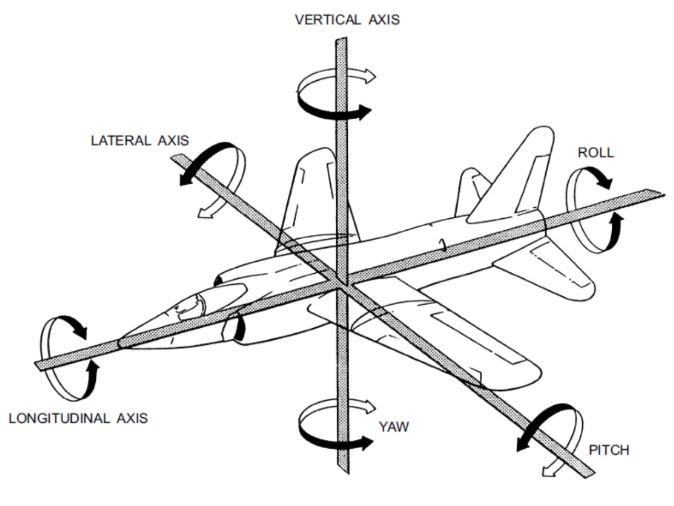
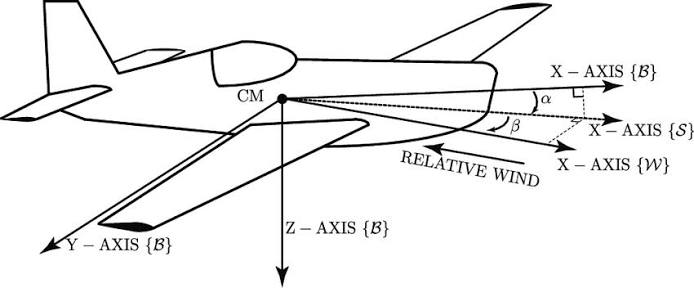
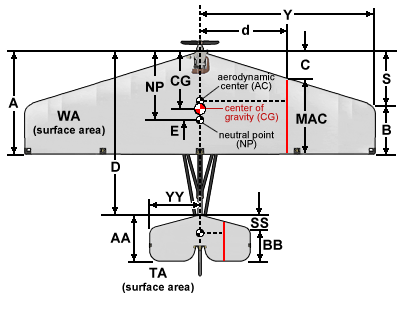
But the two points are not the same kind of thing, and that difference is the whole subject. The centre of gravity is a weighted average of mass. The neutral point is a weighted average of sensitivity — not where the air's push lands, but where the extra push lands when the nose comes up one degree. You can't photograph it. It's real, it's measurable, and it's nowhere.
The static margin is simply the distance between those two points, positive meaning the neutral point sits aft of the centre of gravity. So that everyone quotes the same number, it's given as a percentage of the wing's mean aerodynamic chord — the average distance from leading edge to trailing edge — a constant for a given aeroplane.
That one number decides a safety behaviour you badly want. Pull back, the nose rises, and the aeroplane should resist rising further, because pitching up without limit ends at the stall. It resists exactly when the neutral point sits behind the centre of gravity: the extra lift from the higher angle of attack lands behind the point the aeroplane turns about, and pushes the nose back down. That's what statically stable means — and notice there's no time in it. Displace it; does it push back? Rates come later, from the margin and the aircraft's inertia together.
Put the neutral point ahead of the centre of gravity and the sign flips. The extra lift now acts ahead of the pivot, lifting the nose further, which makes more lift again. Past a point the pitch-up feeds itself and drives you toward the stall, and something — pilot or computer — has to push back continuously.
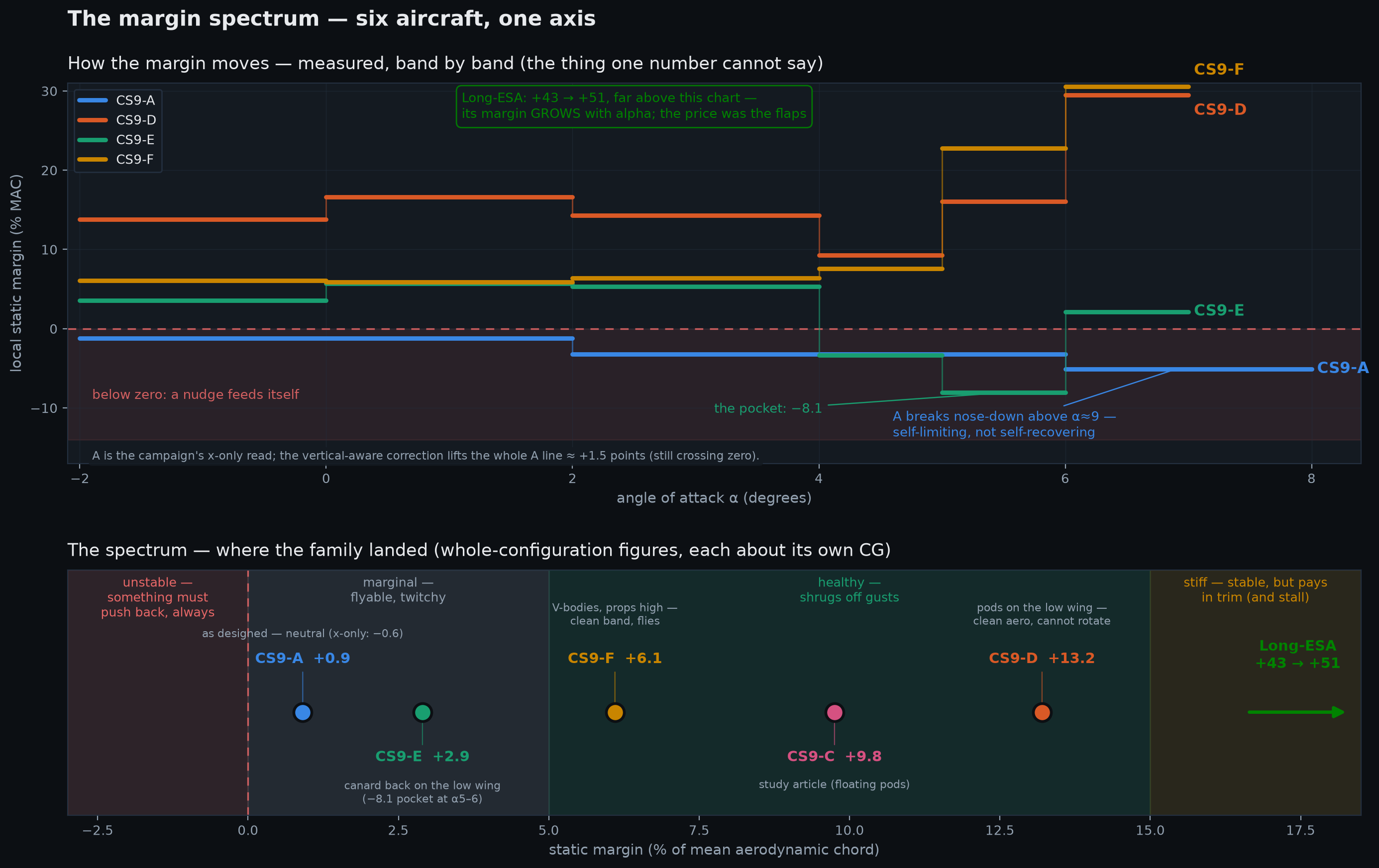
Most aeroplanes have a neutral point that barely moves, so the margin is one number and that's the end of it. The CS-9 A is not most aeroplanes: measured in the flow, its neutral point creeps forward as the angle of attack rises, crossing the centre of gravity in the middle of the ordinary working range. The type's inherent stall protection is real — the foreplane stalls first, its lift goes, the nose drops — but it only engages above about nine degrees, and the divergent band sits below it, exactly where climb-out and approach live. It bounds the excursion; it does not make the band flyable. Normally you would not build an aeroplane with a statically unstable range at all.
You can see the neutral point itself in the dynamic figure below — the blue pin, walking forward as the nose comes up.
What the CS9 was trying to do
Flaps are how an airplane lands slow — drooping the back of the wing makes far more lift at low speed — but they also twist the airplane hard nose-down, and something has to hold the nose up against that twist. Normally that something is the pilot: feeding in elevator, re-trimming, riding the balance change all the way down the approach. The CS9's answer was to gear the canard's own flap to the wing flaps: drop one lever, and the little front wing makes an opposing nose-up twist sized so the two cancel each other. And it genuinely worked — measured, at cruise attitude, the two twists balance to four thousandths of a degree of elevator. One lever, nothing to ride, no balance change: the moment machine the design promised. This is not completely unprecedented. The Piaggio P.180 Avanti has flown coordinated foreplane and main-wing flaps in revenue service since 1990, its forward-wing flaps deploying together with the main flaps for exactly this reason — to hold the pitch trim — on a three-surface layout patented in 1982. The mechanism is proven. What has not been done is doing it small. The Avanti is a roughly $7.7-million, six-to-nine-passenger business turboprop, about 250 of which have been built in thirty-five years. The CS9 is aimed at one pilot, one passenger, and a price a private pilot could actually reach. Making a known mechanism survive that reduction in size, weight and cost is the real question, and it is the airplane this story is about.
The price hides in the geometry. The CS9 is a close-coupled canard — the foreplane sits just ahead of the wing — and a surface that close doesn't just share the flap lever, it shares the wing's air. Its wake washes back over the wing root, and as the nose rises the wash deepens: the root makes less and less of the airplane's extra lift, so the neutral point — the balance point of that extra lift — slides forward, toward and then past the centre of gravity. That chain, wake to root to neutral point, is the flaw itself, and it lives entirely in the shared air no fast method computes. Watch it happen:
The airplane that never had this problem
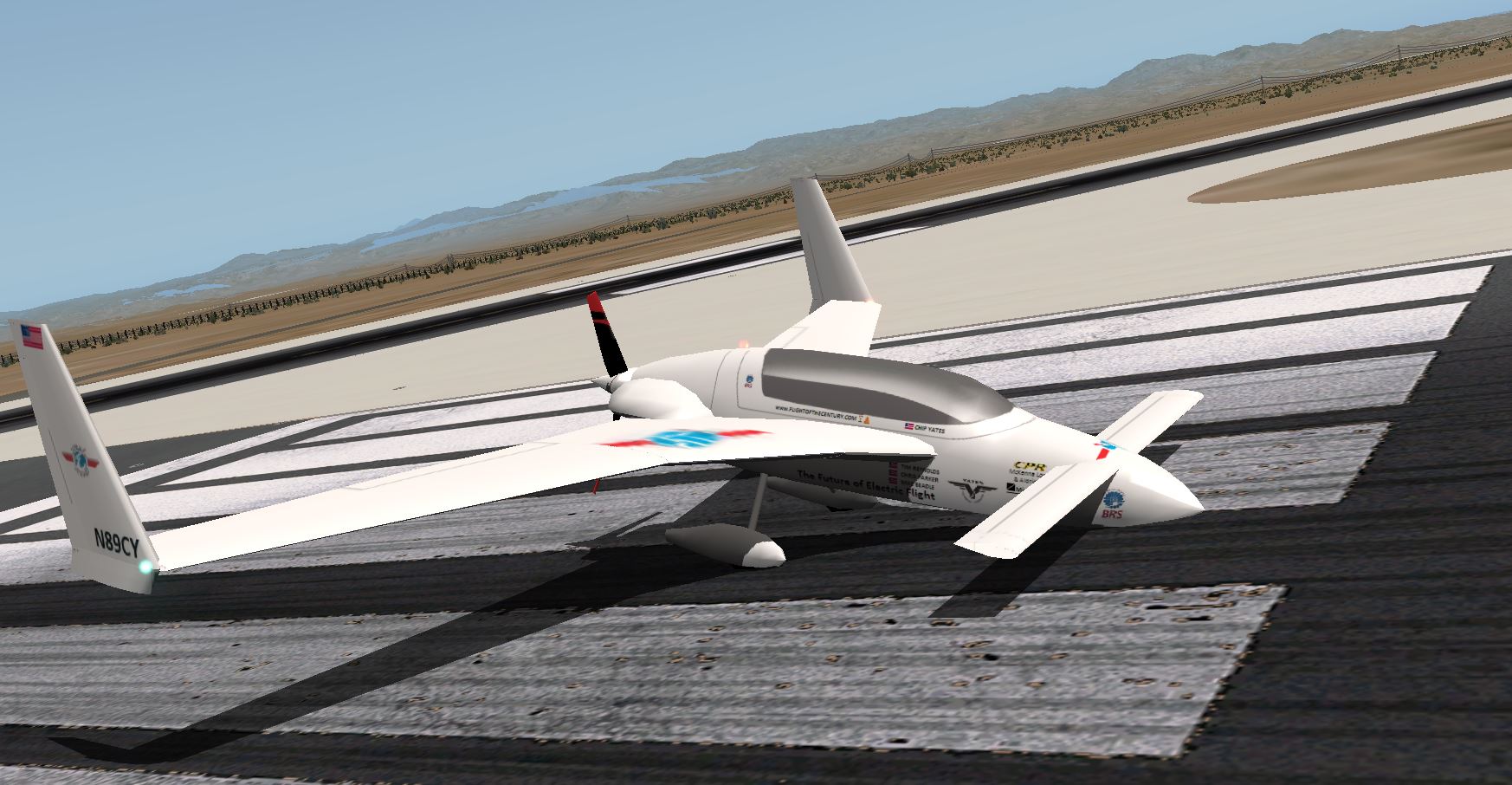
Canards are not the villain. The Long-EZ lineage — here as our Long-ESA, the electric speed-record airframe — puts the canard far ahead on a long neck, carrying real lift, and the same instrument shows its margin growing as the nose rises, +43% to +51%: the safe-stall behavior in its purest form. The price is the other half of our mission. A rear tail counters flap twist by pushing down harder — moving away from its stall. A canard must counter it by lifting harder — moving toward the very stall it is built to reach first. So the Long-EZ family flies flapless, answers "how do I slow down" with a belly-mounted drag board, and accepts a fast landing. Safe stall or short landings: pick one. The CS9 exists because we wanted both.
The journey to an airplane that works
Delete the canard? The margin comes back — and the airplane can no longer land. Flaps-out in the landing flare, the canard-less high-wing CS9 arrives with 94% of its elevator already spent holding the nose up, 1.7° of travel left: no flare, no landing. The gear-together flap system was carrying the airplane's ability to land, and the canard was carrying the flap system.
Lower the wing instead (CS9-D). Drop the whole wing to the belly, move the crew up, put the battery under the seat, and let the engine pods ride the wing down. Aerodynamically this is the cleanest airplane of the family — margin +14.7% across the whole working range, flaps effective, 13° of flare in hand — and it cannot fly. The CS9 is a pusher: with the pods carried down, the propellers sit so low that the airplane has negative rotation clearance, −0.3°. It cannot lift its nose off the runway without striking the props. No flow solver can see a runway; the ground is a design constraint from outside the wind tunnel.
Put the canard back on the low wing (CS9-E)? Measured: you cannot have it both ways. The canard's protective stall returns, but the margin develops a pocket — a narrow band around α5–6 where it dips to −8.1% inside an otherwise stable airplane. The wing itself softens slightly there on every version of this airplane; the canard deepens that dip and lowers the whole baseline until, only on the E, it crosses zero. On this airframe, the canard's protection and a clean pitch curve are not simultaneously available — and moving the canard up or down doesn't fix it, because the softening was never the canard's to fix.
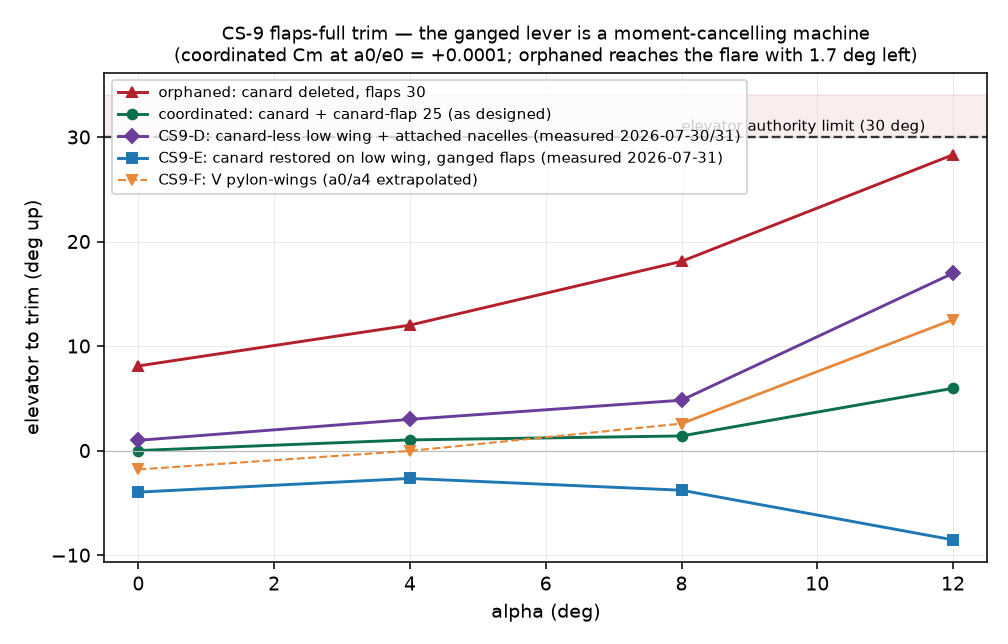
Hold the props high on V-bodies (CS9-F). Keep the low wing and the canard-less honesty of the D, but carry the engine pods at their original height on a pair of short V-set pylon wings growing from the fuselage flanks. Rotation clearance returns — 10.8° loaded, where the D had less than none — and the airplane keeps what the journey earned: margin +6.1%, no pocket anywhere in the band (its worst local value is +7.6%, in the same softening region where the E fell to −8.1%), effective flaps with 17.5° of flare in hand, and elevator authority measured flat through high alpha. And the instrument kept us honest one last time: our first-order estimate said the V-bodies would add stability; measured, they cost a little — their small wings stall at α9 and shed their wake across the elevator, caught by a 48-probe rake with a control station that could have refuted it and didn't. Third time this family's pencil-and-paper prediction was wrong about vertical geometry; third time the measurement caught it before the airplane did. The F flies. One thing the F does not do is deliver the original brief. It has no canard — because we could not make the canard work, not at this size and not with the flaps we wanted. The foreplane fuse that motivated the whole program is absent from the airplane that finished it, and on the F stall protection has to come from somewhere other than a surface that gives up first. What survived is the rest of the mission, and it survived well: the low wing bought the margin back, the V-bodies put the propellers back where they belonged, and what came out is a genuinely good aeroplane for this job — flapped, stable across the working band, and able to rotate. We set out to have both and got one of them, plus an airframe worth building.
The simulator doesn't run the slow instrument in flight — no computer can. It flies the same fast per-surface physics as any simulator, with tables rebuilt from the coupled solves: the price of real time paid once, offline, and every airplane in the hangar carrying the coupled answer at sixty frames a second. Config-A, the CS9-F, and the Long-ESA each fly there on their own measured aerodynamics, gear, and powertrain; in the working band the CS9 handles the way this paper measured, because the simulator carries these numbers rather than re-deriving them.
The CS-9 airframe and CS-9 configuration A (as designed), including its flight dynamics, are credited to Cameron Garner, X-Aerodynamics. The flaw identification and the redesign through the CS9-F are this program's own work.
Appendix: what a fast method can and cannot see
The sharpest objection this work received from independent readers was aimed at its own opening claim — that the flaw was invisible to fast simulation. It is a fair challenge, and rather than argue it we measured it.
There is a middle instrument between the two used above. A vortex-lattice method represents every lifting surface as a sheet of horseshoe vortices and solves them all in one linear system, so the canard's influence on the wing is in the answer by construction rather than bolted on afterwards. It runs in seconds. We put it on the same geometry, at the same references, with the canard on and off.
| method | neutral point | what it actually does |
|---|---|---|
| component build-up (what we flew) | 1.276 m | each surface evaluated in its own clean air |
| vortex lattice (coupled, inviscid) | 1.183 m | all surfaces in one linear system |
| viscous CFD (measured) | 1.151 m | the whole aeroplane in one connected body of air |
The coupled method recovers about three quarters of the gap in seconds of computing. So the objection is right about the part that matters most: a fast method that couples its surfaces would have caught that this aeroplane's margin was not where the design thought it was. What we flew was not that method. It was a component build-up that evaluates each surface separately, and that — not the speed of the arithmetic — is the specific mistake.
What the coupled method still cannot do is the reason the rest of this paper exists.
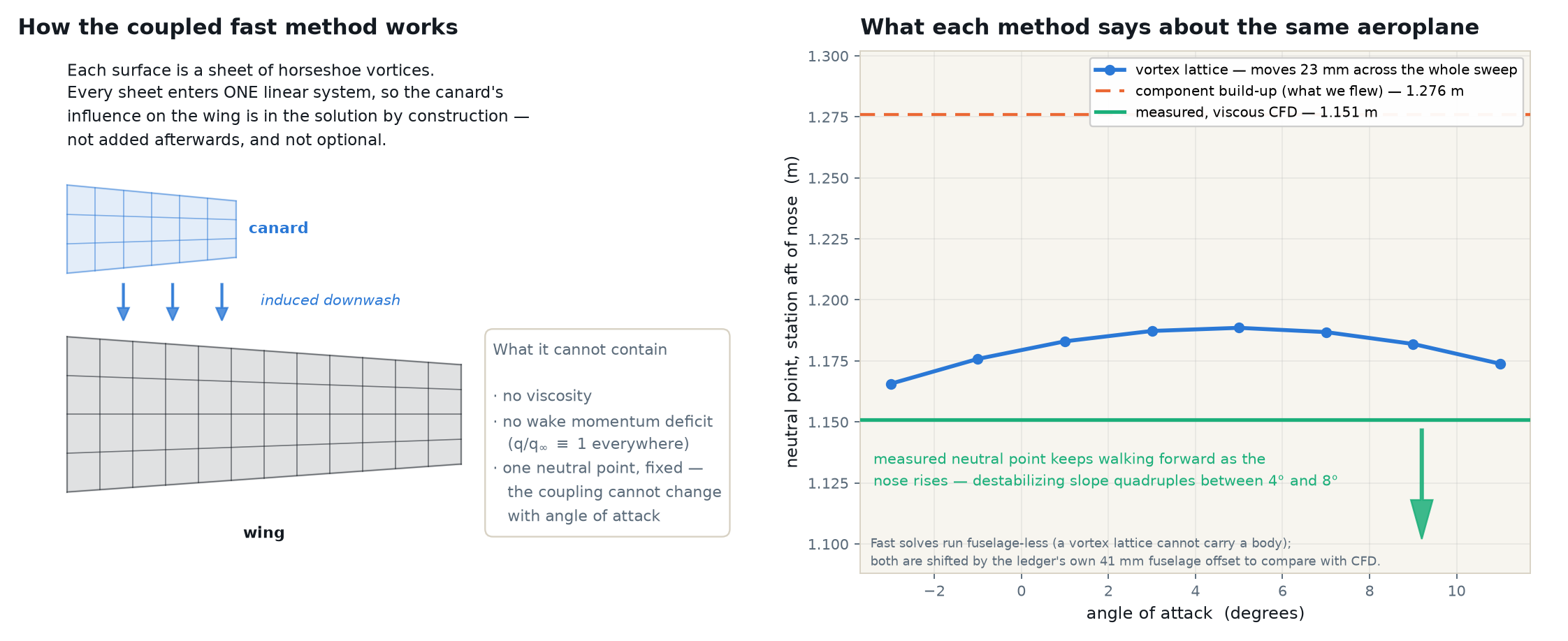
A vortex lattice has no viscosity in it. The air behind the canard is exactly as fast as the air ahead of it, at every angle — there is no wake deficit to deepen, because there is no wake in the physical sense at all. And because the method is linear, it produces a single neutral point that cannot move with angle of attack. The real aeroplane's does, and that walk is precisely what decides how the aircraft behaves where it matters, on the approach and in the flare.
So the honest claim was never about speed. A fast coupled method could see that the margin was lost; only a viscous solve could see how it is lost. And since every real-time simulator — ours included — flies tables computed in advance rather than solving anything sixty times a second, the clock was never the constraint. What matters is which physics generated the tables. That is the architecture this whole program is built on: measure the hard way once, offline, and fly the answer at rate.
Bounds on this appendix: the vortex-lattice runs are inviscid and carry no fuselage, so both fast results are shifted by a separately measured 41 mm fuselage offset to be comparable with the viscous solve. The viscous numbers remain study-tier; a grid convergence study is running at the time of writing, and the neutral-point values here should be read as firm in ordering and direction, not to the last millimetre.
AI transparency
All aerodynamic numbers in this paper come from whole-aircraft RANS campaigns (OpenFOAM/SU2 toolchains on rented compute) with results banked in versioned ledgers; every figure is generated from those ledgers by scripts kept under version control. Analysis, figure generation, and manuscript drafting were done with Claude inside Aaron Kushner's research harness; design rulings and the final word are the author's.